Sunday, March 24, 2013

Statement of Professional Goals

Early Spring, Truth or Consequences, New Mexico


I have been thinking more than writing these last months, observing more than commenting, recording more than sharing. This will end like winter, another cycle completed, different than the last but always familiar. This is not unlike my updated dissertation structure that focuses on reoccurring patterns of human development and experience rather than chronological order. I present at three conferences in the next several weeks. The first is the Historic Preservation Association Conference in Portales, where I will present a cultural history on the Healing Waters Trail as a case study in preservation and sustainability. It will also be a little something something to add to the website for the Trail as it becomes a better known amenity. My second conference presentation is titled “Place Ethnography: Notes from the Field.” My third conference paper will be the foundation of my first chapter using the revised structure, which I covered in my last post, about place and diaspora. I will introduce the groups of people I will write about. All three will be presented here in part first. My most recent writing was a “Statement of Professional Goals as They Relate to the Advancement of the Humanities and Social Sciences,” for a fellowship application. While my chances are slim and the competition fierce, it was a chance to articulate what I want to be when I grow up. I talk a lot about my dissertation committee. I keep excellent company. It is still a draft, but I will make it a public statement for good measure and luck. 

Statement of Professional Goals as They Relate to the Advancement of the Humanities and Social Sciences by Tita Berger

My professional goal is to craft historical, analytical and interpretive place narratives. I want to contribute to local place making activities as an educator, community scholar and activist. These goals relate to the advancement of the humanities and social sciences primarily as these activities serve to articulate how human culture shapes places, how we study these contributions and how we advance scholarship and participation through these practices. These goals are being realized in my dissertation field work and writing. The potential to advance the study of the humanities and social sciences is tremendous in the field of place studies primarily because of its breadth. Place research encompasses a wide variety of humanities and social science fields, drawing from history, art, cultural studies, literary studies, geography, anthropology, philosophy, architecture, sociology, and others, and employing theories and methods that range from photography and ethnography to critical cartography, material analysis and phenomenology. How places are made, how they grow and decline, how they are defined, celebrated, understood, represented, contested, manipulated and claimed, narrated and marketed, the mutual constitution of people and places in identity and attachment, and the role of historical revitalization, environment and social sustainability are all central questions that I seek to explore and articulate professionally as a scholar and place historian. 

My professional goals and the advancement of intellectual inquiry and exchange that I seek to engage have been profoundly shaped by my dissertation committee. I will recount their contributions to the advancement of the humanities and social sciences to illustrate how they have shaped my professional and intellectual goals. Renowned photographer Miguel Gandert’s work documenting the social rituals, people, and landscapes of the region is unparalleled. The starkly beautiful depictions of people in place defy the destructive idealization that often imbues visual depiction of the region and its people. These powerful storied landscapes narrate the historical survival and constantly evolving expressions tradition, landscape and memory and culture. Architectural historian and scholar Chris Wilson’s writings found much of my work in cultural landscape studies and historic preservation. My professional goals encompass the typological and analytical analysis that is central to survey work as well as preservation. Recently I was hired as a consultant to write text for interpretive panels for the historic downtown segment of the Truth or Consequences Healing Waters Trail, a recently opened trail that traverses the town and loops down to the river. It was a delightful experience and unexpected professional honor, albeit much harder than I could have imaged to pen a cogent paragraph-length narrative for eight panels. My work in the Historic Preservation and Regionalism certificate program, headed by Wilson in the School of Architecture, played a large role in getting this work. Michael Trujillo’s dissertation and recently published text draws from anthropological ethnographic field-work in northern New Mexico. His sustained critique is a sharp departure from the romantic ethnographic depiction of people and places that have come to define the region. The practices of people, place, and cultural contests that mark modern places are complex, imbued with trauma, dislocation, violence and heartache as well as perseverance, joy, fortitude and celebration. My own ethnographic field-work, modeled after Dr. Trujillo’s research, has forced me to confront issues of sustained sexual violence, poverty and methamphetamine use, which exist simultaneously with burgeoning art and farmers markets, sustainability projects and revitalization efforts. The historical recovery of the work of writers, scholars, activists and others whose contributions to the advancements of the humanities and social sciences have been obscured and elided is a critical to the continued advancement of the humanities and social sciences. This has been a focus of my dissertation chair, Gabriel Meléndez. His research and writing on the intellectual production of Spanish language newspaper and literary writers at the turn of the 19th century challenge and invigorate current understandings of history, politics and identity. The deeply respectful scholarship that expands the cannons of intellectual work and forges the connections between the academy and larger community is shared by these scholars. The humanities and social sciences advance not just in scholarship, but in these obligations, collaborations and commitments. 

My current ethnographic field work in Truth or Consequences will continue through August of this year. My inclinations to exuberance and sociability have translated into great success in the field, measured by the numbers of interviews completed as well as the densely-packed field books that I have amassed from weekly observations in the town since August 2012.  I have maintained a public research blog on my ethnographic work has been viewed over 1000 times. From this body of research I will craft a dissertation that makes these connections, advances study of the humanities and social sciences, marks their relevance in our daily lives and furthers my professional goals as an educator, scholar and activist.  

********************************************************************************
Here is the final copy of my fellowship letter. 4.9.13 The first one should have read "Welcome to my Dissertation Committee."


Statement of Professional Goals as They Relate to the Advancement of the Humanities and Social Sciences 

Remember: If the Creator put it there, it is in the right place. 
Minquass Proverb

We come and go, but the land is always here. 
And the people who love it and understand it are the people who own it—for a little while. 
Willa Cather, O Pioneers!

My professional goals are to craft historical, analytical and interpretive place narratives and to contribute to local place making as a community scholar, educator, and activist. These goals have been profoundly shaped by my dissertation field work these past nine months, as well as the scholarship and mentorship of my dissertation committee. I believe socially sustainable places create the spaces where the advancement of the humanities and social sciences flourish. Universities are such places, and scholarship advances because of the work of scholars in these places, as well as the work of countless others to ensure that professor and students have the support, facilities and amenities they need to do this intellectual labor. In other places the connections between the advancement of scholarship and research to what communities hold valuable is not so readily self-evident. Place making activities serve to articulate how human culture shapes places, how we study these contributions and how we advance scholarship and participation through these practices. Beyond this however, place making activities serve to illustrate the connections between the advancement of scholarship and the contributions of research to our own lives, histories, families, livelihoods, health and well-being. 

The potential to advance the study of the humanities and social sciences is tremendous in the field of place studies primarily because of this juxtaposition between its breadth and grounding. Place research encompasses a wide variety of humanities and social science fields, drawing from history, art, cultural studies, literary studies, geography, anthropology, philosophy, architecture, sociology and others, and employing theories and methods that extend from photography and ethnography to critical cartography, material analysis and phenomenology. Place studies, while ranging from sprawling philosophical treaties to the confined analysis of fleeting poetic encounters, are grounded in particular experiences of place. Clifford Geertz writes  in his afterword to Senses of Place (1996), edited by Keith Basso and Stephen Feld, and published by the Santa Fe based School of American Research Press, that “it is still the case that no one lives in the world in general” (262). “Everybody,” he continues, “even the exiled, the drifting, the diasporic, or the perpetually moving, lives in some confined and limited stretch of it—‘the world around here.’” Place definitions are many, but for the purposes of my work place constitute connections to identifiable landscapes real or imagined. Long relegated to the backdrop of history, places are emerging as central to how we understand the process and power of culture. How places are made, grow and decline, how they are defined, celebrated, understood, represented, contested, manipulated, claimed, narrated and marketed, the mutual constitution of people and places in identity and attachment, the role of historical revitalization and issues of environmental, economic, political as well as social sustainability are all central to my professional work and scholarship.
  
My current ethnographic field work in Truth or Consequences will continue through this August. My social science background provides me with a solid foundation in statistical quantitative data analysis, powerful tools to uncover and explore patterns and relationships in places, especially given the centrality of data-driven political and economic concerns. My training in qualitative methods, including archival work, historical analysis and ethnographic methods has been honed in the past year. Submitting an ethnographic field work Institutional Review Board application was daunting, but the process forced me to articulate and defend my theories and methods in a manner much different than I had previously encountered. I have had great success in the field so far, measured by over 50 recorded interviews, densely-packed field books, video, photography and other field-based material I have amassed from weekly observations in the town. I have maintained a public research blog on my ethnographic work. Viewed over 1500 times, this public writing exercise has been an anxiety-producing, humbling and exhilarating experience as I seek to describe my methods, theories and observations in-progress. After my year of research, I have a year to finish my dissertation writing. The success of my professional work will be measured by my ability to make relevant connections between advancement of the humanities and social sciences, and their importance in our everyday lives and places. 

Monday, February 18, 2013

Writing History Part II: Spirit of the Past, Eye on the Future


The paragraphs below are a test of the new structure of Welcome to Truth to Consequences: Place and Place Making in Modern New Mexico. Interrupting the linear chronology of many historical accounts, the attempt here is to establish a thematic structure. In other words, I am going with theme over time. 

The narrative I write about Truth or Consequences, the region, the United States of America, and the world, filaments of the larger picture set against the bulky narrative of the town of course, are be shaped by the connection and cycle of events and such rather than a straight shot passage through years. This is the big picture I have glimpsed in my interviews and ethnographic field work. This is only a test.

History is a collection of observations about what possibly occurred, it is not the occurrence itself. All history is a tapestry of qualitative and qualitative assertion. Enough agreement about an event results in the assertion of historical fact. Like scientific findings, facts can be overturned by the presence of more compelling evidence. Miguel Gandert's advise to remember that a photograph is not the thing itself illuminates this tension in history. History is not the event itself, but a story we tell about the event.

No matter how great the effort, there is no history that does not elide and occlude events as equally as it tells a tale of the events that transpired. The tale should be a true one, as far as true can be realized in history as the most plausible combination of the who, when , what, and where and the ever-conjectural and never fully-vetted why. Similar to place, historical truth is always in the process of becoming, never fully realized before it shifts into something else. The following meanders far from history, but it was a fun exercise in the poetic. I will return to the concrete next month, when my interviews resume and I delve into the Museum's archives. 


BEGIN TEST 

TEST 1: Theme as Historical Structure.

THEME 1: Diaspora: The movement, migration, or scattering of people away from an established or ancestral homeland

Place is the concentration of countless diasporas. Diaspora is too narrowly imagined as human movements away  from homelands. Molten lava, flora and fauna, landmasses, seeds, molecule of dirt and other physical things made their way across the surface of the earth before sentient beings and offspring. People did not migrate first. They were not the the first to claim a geographical territory. The separation of people and the material and physical fragments of place is folly, we are a part of the earth, made from dust and mud in most creation accounts. To separate people from their ancestral places is an even greater folly, but one that has been born by most every people in the modern colonial era of Spanish and American and now gobal systems. 

The movement, migration, or scattering of people away from an established or ancestral homeland scatters seeds and earth as well as stories. Stories are where places begin. Nothing has a claim to place without regard for a “before-time.” No place is ever composed of self-originating material. We all come from somewhere, but none of us started here. And yet. We mark beginnings in reference to particular places and homelands. We are born to places, but this is not necessarily the strongest claim to place. Wildly varied in cast, character and content, no story happens without a place. And no place becomes a homeland without stories describing how that place became home. 

Culture is place in important ways. Culture is what emerges from long stays in a particular places, and from merging old place habits into new landscapes. Foodways carry place as much as the clothes on a person’s back used to carry place. The loss of the first has created a far greater outcry than the second in contemporary times. The resurgence of interest in local foods accompanies the possibility of regaining some literal ground to farm. Yet the second example of place and culture and the clothes on our back demonstrates how place and culture weave together. The wool worn over by English immigrants carried the story of the loss of common land. Our material culture carries place both literally and figuratively. Captives carry culture; root it in new places where it grows like a story told and retold whose witnesses can no longer testify to the truths of the before days...

Regulated to the backdrop as a stage where history happens, place has been denied an active role in the shaping of people and history in modern tellings. Not always of course. The historical record is a record of movement. This is likely a reason why the old records of people and places, once largely cyclical, are now given over to the linearity of forward movement. Progress replaces old rituals with new ones anew given the slightest chance in modern histories. But there are some ruptures in this linearity. A Thousand Years of Nonlinear History by Manuel De Landa provides a different structure and method.... 

People are born to places and claim them readily, and just as readily other would dispossess people of their land. Boundaries are marked, settlements expand, history is written, war comes and these actions are erased and re-inscribed. “How does the colonial imagination,” asks scholar Annette Rodriquez, “make landscapes teeming with people and settlements into empty places?” The colonial imagination she refers belongs to both Spanish and the American colonizers who spread across North America. The Spanish acknowledged that the lands they sought for golden cities and god glory were otherwise occupied. The Americans embraced the paradox of erasing Native settlement when it suited them, or celebrating the people of the long-settled landscape they claimed through politics, rhetoric and war in bizarre ritual and dress-up. We do that today with the same brutal flourish of fantasy and reverence...

END TEST.


Monday, January 21, 2013

Writing History

Apache prisoners of war en route to Florida camps.
Nueces River, Tex. September 10, 1886.

There is little on Lozen in the historical record. This much at least is considered historical fact. The photograph above is said to be her only recorded image. If this is an accurate assertion, she is seated at the top, the sixth woman from the right. The historical record, and the archives of observation which found this record, are not any guarantee of accuracy. This is not revelatory. In the who, what, when, where and why of journalism, for instance, the margin of error is wide. The margin of omission, however, is immense.


Other kinds of record keeping and archives, like death and taxes, or their records at least, fare somewhat better. Not always. Gaping holes where where people and their stories have fallen are in every place, archive or unmarked grave. The pit of what we don't know is bottomless. What we do know, or claim to know, is the tenuous truth we hold out as history  Beyond the truth of omission and just plain poor observation is a bigger issue however. This concerns the question of the how and who of history writing as a method and history as a product. Also at issue is the idea that the written record is the superior instrument; both a fact and its own record of progress. Each is at stake in the writing of history, particularly the kind of public history I am interested in writing about when I write about places. 

Lozen, an Apache women whose warrior legend is the stuff legends are made of, illuminates with her contested history the ways that places, like people, can be carried away and vanish. With these losses our storied landscapes lose their shape and power. There are always new place narratives being spun, however, to explain why this land is our land. America has used Native American histories, individual and communal, to assert a national identity while simultaneously erasing the  violence that accompanied these encounters. The habit of populating the national imagination while depopulating the land was also two-fold. Land long-settled by  different cultural groups was called vacant or open, or, when settlement was harder to ignore, the lament of the vanishing native was sent forth to create a future vacancy. The twin tale of either vacancy or imminent demise did nothing to diminish the importance of ‘playing indian,’ in creating an American Identity. Philip J. Deloria Playing Indian (1998), originally a dissertation at Yale, looks at how America uses the idea of ‘Indian’ to create their own national identity, think Boston Tea Party and noble savage, or Buffalo Bill and dime novels. Lozen's story, as it appears in two recent published writings, illustrates how place narratives that seek to establish the power of place in the contemporary moment can diminish places when they are spun from air and conjecture, even in good faith.  But they follow a pattern of negligence long established. 


Decolonizing Methodologies: Research and Indigenous Peoples (1999) written by by Linda Tuhiwai Smith, is an excellent text about history as a tool of power and domination. That is history with a capital H, generally a national history. The western model of knowledge accumulation is a violent record of abuses, and the knowledge accumulated not nearly the objective body of 'this is what happened' fact that it is billed to be. There are many books that challenge the ways that we learn about the world. Our sense deceive us, our bigotries blind us, our paradigms control the way we process the most simple phenomenon, and whole sets of truths that govern the 'way things are,' are overturned with a startling regularity. How to counter the 'truth' that is woven into the lessons we learn when we are learning our lessons at school and in the world? To paraphrase a great bumper sticker, It is hard not to believe everything we think.

Tuhiwai Smith develops an argument against history by drawing on theoretical critiques that characterize history as a specifically Western project, tied to the Colonialism, Imperialism and the Enlightenment. The Enlightenment, so often articulated as the rise of reason and progress, saw the rise of the major political and economic structure shaping dominant understandings of the world and people in it. The resulting global system justified the death and destruction of all the people who were already settled on lands that Spain, France, England, other Europeans Nations and eventually, the United States. It still does a pretty nifty job of death and destruction, whose latest casualty seems to be the planet itself. But that is a whole different story, or maybe it is really the same story.

The end, fortunately, did not materialize for the first world's established populations prior to colonial encounters, although it may still be coming for the lot of us. The 'eventual' disappearance of all of these people in the face of 'progress,' was never realized, although we still love a rousing “Last of the Mohican's” moment in our narratives. Vanishing way of life and all that, generally characterized as inevitable in march of "progress." The horror has marked and destroyed robust cultural systems and killed so very many people, and continues to do so, is real. But so is the persistent underestimation about the resilience of a whole lot of cultures and settlements of people.

Tuhiwai Smith 's work connects the project of history with imperialist ideologies, like those of savagery or inferiority, and develops a list of ideas about history. Mainly, that histories need to be subject to systematic critique, both from inside indigenous communities and outside in places like Universities. Her list includes “the idea that history is one large chronology,” which refers to the discipline of history, not the stories that people tell about their past (30). These stories, she argues, are “reclassified as oral traditions rather than histories” (33). This is a pretty well-know debate in Native American communities. “'The talk'  about the colonial past," she writes, "is embedded in our political discourses, our humour, poetry, music, story tellings and other common sense ways of passing on both a narrative of history and an attitude about history” (19).

These ideas are well-known in academic fields that employ critical theory, where I have spent way too much time, as evidence by  this very post. Or not enough. I struggle to not recreate these kinds of histories, where as a scholar I am allowed to imagine the power to tell and ascertain fact is mine, like some terrible Spider Man-like responsibility. This is what I do though, scholarship, and I would like to do it well, even if I am a grain of sand on the beach of written history. And by well I mean I would like to write things that are as close to accurate, fair and just to the parties involved as possible.

The study of place narratives brings fiction and history into constant tension. The line between the two is decidedly blurry. This is certainly true in the southwest, where so much of what people thought they knew what part myth, part bullshit, part conjecture, part survey and high adventure tale, part imperial project, part romance, part dime store novel, part longing, and so on to the hundredth part. How different history and fiction are, or are not, is what the above paragraphs are getting at in a more academic way. And yet there is a line crossed when history become fiction, and sometimes it is pretty clear. Sort of like the line that television crossed when reality became a genre.

Which, brings this post back to Lozen. in an academically-winded and meandering route. I have not done enough research to talk about Lozen's history as much as is know, which is really not much, but there are some big recent issues with that history that have prompted this post. The first issue was with a paragraph brought to my attention by Sherry Fletcher. I do live in fear of her eagle-eye, a healthy fear to be sure. An unfounded assertion is like a fat field mouse doing a jig in a field at suppertime when Sherry turns her gaze to a writing.

Here is the first example that features Lozen and promoted my first-of-the-year post. It is published in the most recent edition of the Sierra County "Official 2012-2013 Visitors Guide." After noting, on page 12, that the U.S government established forts and maintained troops in Sierra County to make it safe for the flooding hordes of miners, ranchers and farmers to to the newly claimed territories, which also "forced several bands on the region, including the Warm Spring Apaches into reservations, the "Truth or Consequences" narrative moves to Lozen. Here is the paragraph in total:


Art by Timothy Thixton,
a former student in Truth or Consequences. 
"One of the most colorful characters was Lozen, an Apache woman said to have ridden as a warrior with her brother Victorio, and later, with Geronimo himself. According to accounts, she fell in love with a Confederate deserter who had been sheltered by the Apaches. When a wagon train came along headed to the California gold fields, he left, breaking Lozen's heart. She never married, devoting herself instead to using her unusual powers to sense danger and heal people."


The passage was lifted, verbatim with several others, from page 205 of Spirits Of The Border IV: The History And Mystery Of New Mexico written by Ken Hudnall, Sharon Hudnal. I am listening to his radio show (kenhudnall.com) as I write this. Pretty interesting. I have emailed Mr. Hudnall and requested clarification and a source for this assertion. Perhaps Mr. Hudnall wrote the piece, which is un-authored. I will follow up on this story. I hope it is bullshit, of course, because it sounds like a load of crap. From what I have read in the archives and in books thus far in the last few frantic weeks of research, Lozen would no more have been broken-hearted from a raggedy southern soldier than she would have been...I do not know how to finish that sentence. Maybe it was a tall, black and handsome soldier from the South. I should not write something like that--it may be quoted in some other account.  

As a side note, just to drag this out a little longer, the publication is a "Co-op Participant in New Mexico True," the newest branding slogan for place narratives sanctioned by the New Mexico Department of Tourism. According to the Albuquerque Journal, the $2 million dollar campaign, coming out of Texas (how grand, Texas), shows “Things that are just an activity somewhere else … in New Mexico are true experiences because they are immersed in the landscape; the culture; the people. … We wanted to bring to life the feeling you get from a New Mexico vacation," according to the Tourism Secretary (4.17.12).

A similar story about Lozen also appeared in the January 2012 Chapparal Guide. This one provides a lengthier history, and refers to several of the texts that explore the few collected the oral histories that were recorded by historian and educator Eve Ball, as well as a few other accounts of the Apache people. The problem with this story is that is quotes a fictional account of Lozen's life as though it were a biographical passage. In other words, the author quotes Tom Diamond's story Apache Tears (2008), which is according to the inside bibliographical page, "A work of fiction based on historical personas and occurrences with dramatization of characters " In other words, a work of fiction.On the back of the book, as a side note, is an "inevitable destruction of their way of life," moment. 

Historical fiction is a genre that is eerily close to reality television. We want to believe that it is real, even though we know that it is not. The author of this article, who I have heard very nice things about, quotes Diamond as though quoting a historical account. Here is the difference, which is not blurry in this case. History is drawn from observation, or from a record of observation. Fictional accounts do not count. Stories do count. While all data is merely observation, the trick is to observe as accurately as possible. History may be fiction, but fiction cannot serve as history. Stories can count as both.  

How we privilege the observer's accounts returns this musing to Tuhiwai Smith, and to the problems of history, research and writing that so many scholar struggle with as outsiders to communities, even if they are merely coming home from college. Once you are trained in a method, especially the same methods that produced such brutally inept, violent and exclusionary histories, how do you write something that is solid and good? I draw wisdom from one of my favorite fictional books. This book made me curious about the Hatian  experience in America. The quote was from a wise-women figure in the text, who said something along these lines (and don't quote me on this): knowledge is labor--you have to work at it. 

This brings me to my last observation of the new year. I always encourage my students, after I misquote the knowledge is labor bit in my opening lecture, to find wise people to emulate. And most wise people got that way by being avidly curious, being passionate, persevering through hardship, and working hard. Writing history is very hard work. Writing good history is harder. Even getting a post out is daunting. But the commitments forged, even with people who are long past knowing what is being written, are strangely compelling. Maybe that is why people keep writing histories, because they feel compelled to tell the stories, buried in the landscape, calling from the ground. In Following the Equator, Mark twain wrote that the "very ink with which all history is written is merely fluid prejudice," and yet he never put down his pen. 

Monday, December 31, 2012

The Power of Place: A Year in Review


The iconic Baptist Church steeple pierces straight through the full moon, which rests briefly on its pinnacle before floating free into the winter night sky. Arrested by this ephemeral spectacle of sublime beauty, I grab my camera and shot out the window. This is probably a pretty funny spectacle itself, inching along in car with a camera balanced on a half-open window, a portrait of the modern place voyeur and bad driver wrapped up in one. This kind of place narrative seeks to capture fleeting phenomena. Whether unexpected or iconic, a good images captures a sense of feeling, a great images captures a sense of place. The curve of moon rests on a church spire, and then floats free. Places are treated like steeples. Fixed and permanent. Rooted in the geography of a town and its history. But places are more like the moon. Waxing and waning. Pulling at us like the the tides, without us knowing. Never really fixed, never wholly rooted, just on a wobbly orbit, albeit regular and largely known. This is where a great many theories on place are moving to, the idea that place is a process and not merely a fixed geographical location. This does not mean that places are not real in the physical sense, or geographically knowable. It  does mean that place is no longer a mere backdrop where history is staged, but something to be studied as powerful in its own right. But they still make lovely backdrops.  

A picture used to be worth a thousand words. Most are only worth a few words now, as many as there are.We are overrun by images. Romanticized, deftly poignant, pop-culture clever, photographic images are isolated from their surroundings in place and time. A rusted car sits amid the lovely ruins of tumbled gates and fences, an old pickup in faded blue sets off the dusty green of a faded playground, boys sitting by a pond seem timeless in black and white. The quintessential truth of photographs is that they lie. Photographer Miguel Gandert, who sits on my dissertation committee to my great delight, told me this when I sought photographic advice. "Just remember, the picture is not the thing itself." But a good picture fools us into believing it is the truth of a thing. 

Miguel Gandert. Nuevo México Profundo: Rituals of an Indo-Hispano Homeland (2000)
The thing itself is a complex animal with teeth and claws, blood and bone.The thing itself is a tortured girl tied in the back of a truck by Ralph Edwards park. The thing itself is land abandoned as economic opportunity flees to countries where little is often worse than nothing. The thing itself is the world moved on from one war to the next, minus the boys who lived here and never came home. The thing itself is the the methamphetamine-carved flanks of boys young enough to have good teeth still, in a new kind of war. The thing itself is the full moon on a homeless man shambling down Austin on a cold night in December on the Friday after Christmas. The thing itself is not the brilliant moonstruck placescape I am trying to capture from a warm moving car that passes him quietly in the night. The thing itself and the place that holds it have a curious relationship. 

"Corner of 5th and Central"
by Levi Romero
in A Poetry of Remembrance: New and Rejected Works (p. 105)

My name is Keven
rhymes with heaven
I'm the most photographed
homeless man in town

contrary to what the
bible thumpin' Jesus servants told me

I am not lost

I am on the corner of 5th and Central
albuquerque, new mexico
united states of america
northern hemishpere

the planet is divided up into four quadrants...


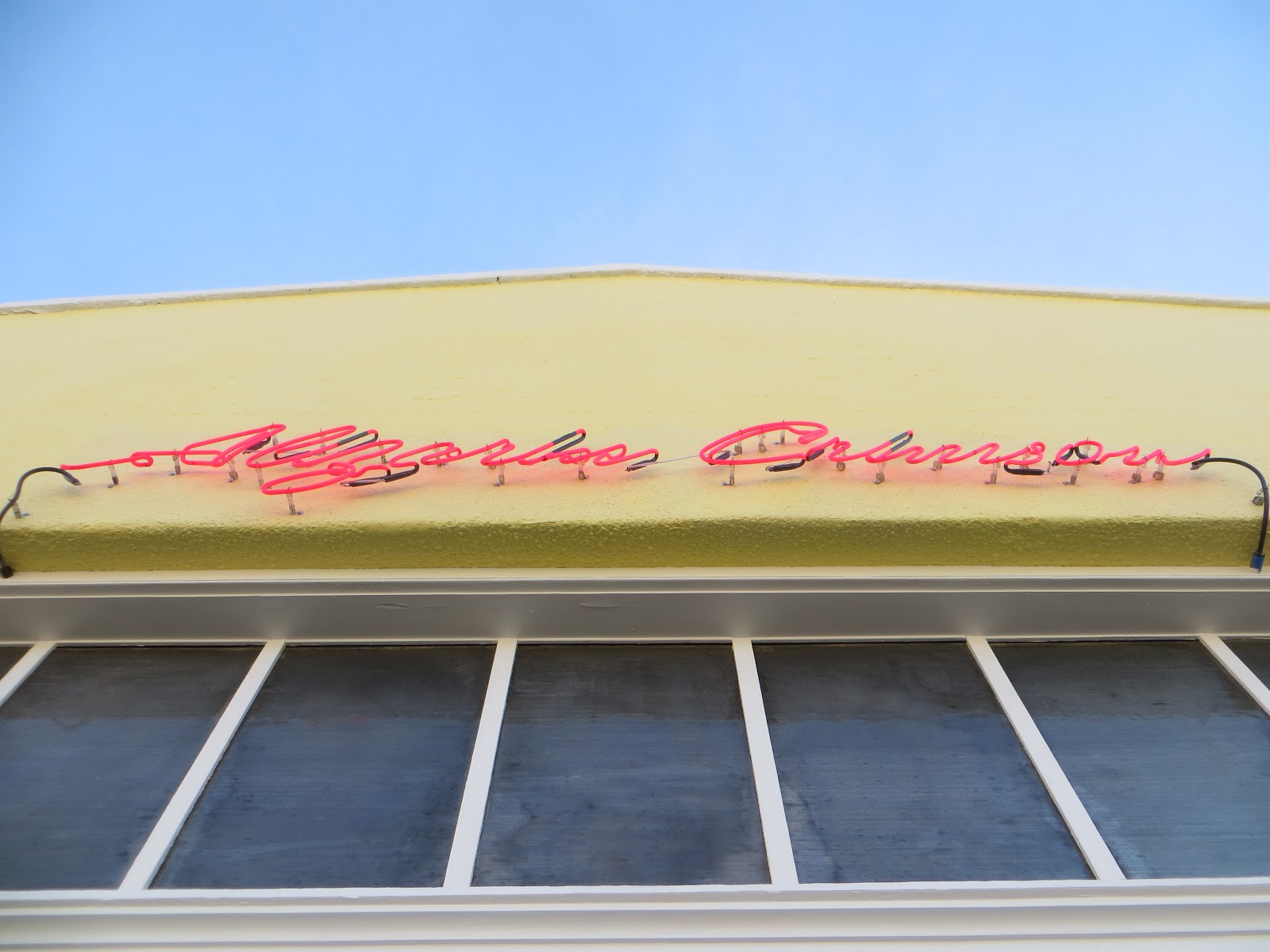
The star at the north corner of the Palomas Hot Springs Bathhouse photographs nicely. I love that star. The  pink neon shutters down into smaller and smaller blue stars. The swift cascade goes black for a moment and repeats  The continuous cycle of bright pink and blue and black. I am buoyant at regaining my momentum, lost during my month-long illness. My day was great. I talked to a couple I had been wanting to meet after an accidental conversation at the Passion Pie Cafe. I had dinner with Sherry and Baxter. I had some incredible new ideas about the town, what Sherry calls her 'Ah Ha' moments, when certain things become clear and patterns emerge. Part of this was the decision to re-work my history into something that does not replicate a too-simple linear timeline. Part of this was the people I talked to on this beautiful Friday in December  I realized that a similar place narrative was present in almost every one of my new-to-town, in varying degrees, resident interviews. It is a narrative that speaks to a deeply-rooted place belonging that comes from something other than the a history of being in a place. I am buoyant, and there was the moon shining like a beacon in the night sky. Then the homeless guy went and ruined my landscape, and I was once again pulled under by the weight of the thing itself. The thing in question is, broadly, the colonial violence necessary to settle any land that is peopled and claimed, no matter how often it is called untamed wilderness or wild frontier. That violence is everywhere, but carefully edited from our histories until it resembles a photograph of a civil war battlefield on a marker by the side of the road. But these histories echo in modern acts of violence and resonate in contemporary struggles with poverty, abuse and addition. But they also echo in the history of triumphant, or stories of  struggle without triumph but struggles nontheless. How can these place narrative get written? Scholar Delores Hayden, in The Power of Place: Urban Landscapes as Public History, (1995) explores how several contemporary public history projects have sought to embody a more honest history of place, and in doing so have been vital sites for community engagement and transformation. 

“It is in providing outward display for things and pathways as they exist within the horizons of landscape that places enable memories to become inwardly inscribed and possessed: made one with the memorial self. The visibility without becomes part of the invisibility within.”
― Edward Casey. Remembering: A Phenomenological Study (1987. p. 213)

The truth of a thing, or a place in this case, can only ever be partially known. Back stories are endless. History is obscured, buried, re-fashioned and re-told. Sometimes, as is the case with the Apache warrior Lozen, which will be my New Year's narrative, the contemporary story is nothing but careless fiction. But that is a fairly common characteristic of many of our stories, especially our place stories. The story I will write about Truth or Consequences has begun to emerge, and I hope to inscribe in this written landscape a complexity and fullness that is its due. I am thankful for the countless people who have opened their homes,  hearts and histories to me these past months. I stop one last time on my way north, to take a photo of the three lights that sit on-top of the rise where the interstate traverses Alamosa Canyon. As a child I always marked the the top of this canyon the arrival point to Monticello, and, by extension  T or C. There is something reassuring about these lights, and I am glad they will mark my return here in a few days when the year is new again.    


Friday, December 14, 2012

The Healing Waters Trail: A Photo Essay